Formation and Attributes of Cumulus Clouds
— Future of RDC Research —
First uploaded on 2026/01/28
Last updated on 2026/08/29
Copyright(C)2026 jos <jos@kaleidoscheme.com> All rights reserved.
We have explained the RDC scheme,
which is a transport process from cumulus domains to their surroundings.
However,
the current version of the RDC scheme does not address
how cumulus clouds themselves would form and what attributes they would have,
instead leaving it entirely to existing models.
For an ideal research development,
it seems we implicitly assumed
analyses in cumulus-resolving models for the RDC scheme use,
similar to our original study using a simple 2D radiation-convection model DCM.
This is because the formation and attributes of cumulus clouds
are most reliable
whey they are obtained from these models
with least ambiguities and external assumptions.
Within a cumulus-resolving model,
cumulus clouds form
and all their internal physical attributes are determined,
according to the model's equations of motion.
Therefore, when applying the RDC scheme,
these can be used as-is.
Furthermore, outflow from cumulus domains to their surroundings
is actually computed within the model itself.
This allows comparison with the outflow when the RDC scheme is applied,
enabling us to ultimately verify the correctness of the RDC scheme.
On the other hand,
users of models that do not explicitly compute cumulus formation
may find the RDC scheme incomplete.
This is because formation and attributes of the cumulus clouds
are determined by the model's assumptions
which are not related to the RDC scheme.
In this case,
the physical processes assumed by the model and the RDC scheme
may not be fully consistent.
However, even then,
as explained in the latter part of the explanation page,
it is possible to balance the mass flux throughout the entire atmosphere
by connecting the two calculations
via the net upward mass flux at the cloud base,
for example.
And at the very least,
it should be possible to compare the cumulus detrainment flows
between the conventional model calculation and the RDC scheme calculation,
presenting the differences.
As stated above,
we are currently proposing the RDC scheme
as a transport process from cumulus clouds to their surroundings.
We consider verifying this process to be the top priority.
This is because this process determines the distribution
of water vapor in the atmosphere and is climatologically significant.
Our next task is
to predict the formation and attributes of cumulus clouds
from the RDC perspective.
Ideally again,
this task will hopefully performed using the cumulus-resolving model.
This new analysis should enable us to determine conditions
from not only the convergence of large-scale dynamical fields,
but also the thermodynamic balance considering RDC
within each RDC-partition
and the local convective instability.
This is neither a matter of trial and error nor parameter tuning,
but rather an inevitable process
guaranteed by basic thermodynamic relationships.
Those with a rich imagination will understand that,
when based on the thermodynamic principles underlying this RDC scheme,
we have a great potential to describe
the radiative-convective system completely,
or at least with the precision required for climate prediction,
using fundamental physical laws,
not reproducing phenomena as has been done previously.
Due to the bounding of flows and energy by thermodynamic relationships,
physically impossible flows or runaway energy balances do not occur,
even when used for long-term climate predictions.
This is highly exciting work,
and we are eager to participate with strong interest.
[NOTE]
Although the tropical region is a convergence zone on a global scale,
the formation of individual cumulus clouds in this region is thought to be
directly related to local convective instability and thermodynamic balance
rather than large-scale dynamic convergence.
These relationships are more likely to be established based on the RDC scheme
than based on any other physics.
[NOTE]
Research on RDC and cumulus formation does not require expensive,
realistic global atmospheric models.
Rather, as in our original studies,
using a simple radiative-convective model with a box-like domain
makes it easier to extract the relationship between the two.
When we are provided with an environment where we can focus on the research,
this analysis using our DCM as an extension of our previous work
will be the first subject of our own.
We will be able to discuss the differences in atmospheric geometries
between 2D and 3D as well.
[NOTE]
If the temperature and water vapor content
within cumulus clouds can be obtained,
then it is possible to calculate RDC.
For example,
our KCM theoretically calculates physical quantities within cumulus clouds.
When a value of relative humidity,
which is expected to result from enough mixing due to cumulus convection,
is provided externally,
the temperature lapse rate and water vapor content can be calculated.
Assuming RDC to occur,
we can diagnostically calculate
the net upward mass flux
that the cumulus cloud must possess to sustain the outgoing RDC flow.
Additional consideration on local convective instability
should allow us to thermodynamically calculate
the timing and location of cumulus cloud development.
Of course,
since this method is not based on strict dynamics,
it may differ from actual cumulus development in minor details.
However,
for the purpose of climate predictions over long time intervals,
we believe it will serve as a sufficiently usable calculation scheme
that satisfies thermodynamic relationships.
Once we can predict cumulus formation, the RDC scheme will be perfected.
Thereafter,
it will be possible to perform climate projections
by integrating the coarse-resolution atmospheric model
with the RDC scheme built in
over long periods,
rendering costly high-resolution cumulus-resolving models unnecessary.
We do not believe that
detailed computations of fine turbulent vortices within cumulus clouds
in order to calculate Dynamical Detrainment
are necessary for climate prediction.
[NOTE]
Atmospheric dynamicians may wonder whether it is even possible to infer
the properties of cumulus clouds based solely on thermodynamic considerations,
without taking detailed dynamics into account.
Here we show a figure from our original study as a clue.
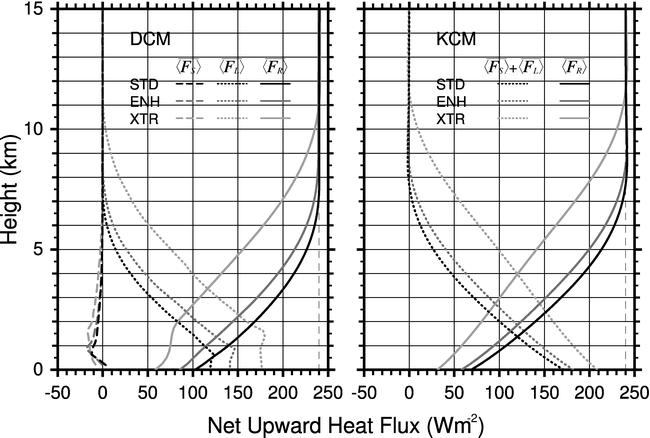 Figure FLUXES.
Time- and horizontally-averaged upward energy fluxes.
See the text below.
These are vertical profiles of time- and horizontally-averaged upward
energy fluxes of sensible <FS>,
latent <FL>, and radiative <FR> heat,
obtained from the DCM (left),
which explicitly accounts for all the flows
including the dynamics of cumulus convection,
and the KCM (right), which includes only the RDC flow.
(The angle brackets < > show averaged values.)
The three different cases correspond to the normal condition (STD),
weak warming (ENH), and strong warming (XTR,
a 2°C temperature rise in the atmosphere near the surface
compared to the normal condition), respectively.
Locally, in the DCM,
there is an order-of-magnitude larger upward sensible heat flux
FS in the updraft region of the cumulus clouds.
However,
this is almost entirely canceled out when averaged over time and horizontally
due to the weak downward sensible heat flux caused by subsidence
in the wide region outside the cumulus clouds.
In any case,
it is clear that the latent heat flux and the radiative heat flux
work together to maintain a constant upward energy flux 240 Wm2.
This constant total upward heat flux balances
with the constant downward short-wave radiation flux from the Sun,
resulting in radiative-convective equilibrium.
The heating rates can be obtained
by taking the convergence of the corresponding heat flux.
Since this was obvious, we did not show every heating rate in the paper.
However, this figure clearly shows that,
in an atmosphere in radiative-convective equilibrium,
the total amount of radiative cooling is balanced
by the total amount of latent heat released.
In other words,
if the radiative cooling rate is correctly estimated,
it is possible to calculate the amount of water vapor that condenses
within cumulus clouds;
that is, the amount of precipitation.
Many people believe that precipitation cannot be predicted
without detailed calculations of cumulus dynamics and cloud microphysics.
However,
if we limit ourselves to the level of accuracy required for climatology,
it is possible to estimate precipitation
as long as the radiative processes are calculated correctly.
In fact,
in the right-hand figure for the KCM,
which does not take dynamics into account at all,
the only quantities calculated within the model
are the profiles of the upward radiative heat flux <FR>.
Nevertheless,
it is possible to estimate the dynamical heat flux
<FS>+<FL>
as the compensating flux and, from that, to estimate precipitation.
For example,
one can discuss how precipitation levels will change
qualitatively and quantitatively
from a radiative perspective as global warming intensifies
without delving into the detailed dynamics or cloud microphysics.
This discussion is possible based solely
on the results of our old, simplest RDC study.
If RDC research progresses further,
it will become possible to identify the properties of cumulus clouds
in greater detail.
It is not out of the question to estimate flow patterns
using thermodynamics and, ultimately,
to develop a new theory of cumulus cloud dynamics.
Thus,
demonstrating that cumulus detrainment flow
can be represented by the RDC scheme
within an atmospheric model is
our current goal and the starting point for everything.
Even if you don't have an atmospheric model to verify the RDC scheme,
we will build a simple 3D radiative-convective model,
with explicit treatment of cumulus convection,
from scratch,
if we are given the development environment.
We hope many researchers will take an interest in
the RDC scheme
and join
the RDC scheme project.
Many researchers in atmospheric physics seem to be aiming for an almighty,
universal model capable of predicting everything
from tomorrow's weather to the climate 100 years from now.
But who needs a conveyor belt shaped like a humanoid?
Contact Us
First uploaded on 2026/01/28
Last updated on 2026/08/29
Copyright(C)2026 jos <jos@kaleidoscheme.com> All rights reserved.